Introduction
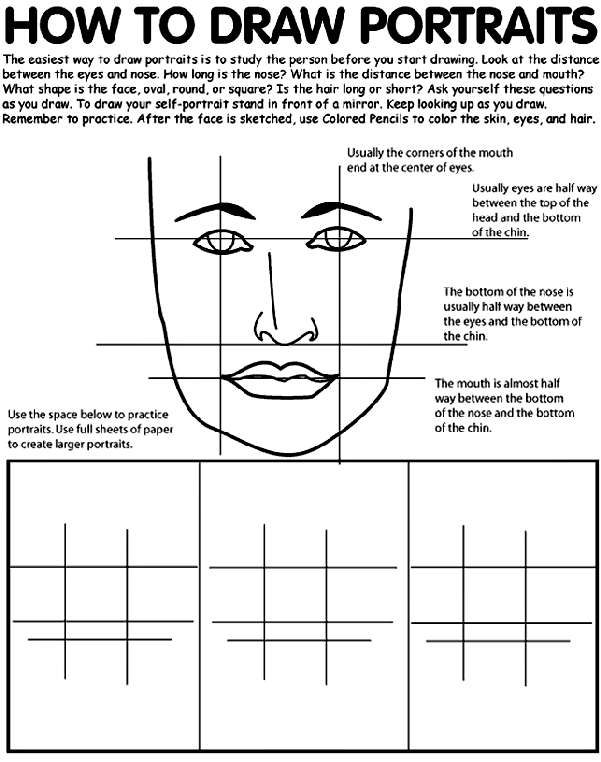
Grid drawing portraits involve breaking down reference images into manageable coordinate squares to teach children proportional accuracy, spatial reasoning, and visual observation skills. According to the National Art Education Association (NAEA), structured visual exercises that employ grid systems successfully bridge the cognitive gap between abstract observation and concrete motor execution in early elementary learners. Utilizing printable worksheets alongside real photo visual flashcards transforms complex facial structures into achievable geometric segments, fostering confidence in foundational fine arts. These hands-on activities support early childhood cognitive development by refining hand-eye coordination and enhancing left-to-right scanning habits essential for academic success.
Visual Learning & Skill Snapshot:
- Core Focus: Systematic spatial division for realistic facial proportions and fine-motor control.
- Target Skill: Spatial reasoning, visual discrimination, and fine-motor proportion.
- Key Recommendation: Begin with 2×2 or 3×3 grids before progressing to complex multi-square templates.
Core Principles and Visual Learning Overview
Grid drawing portraits function by decoupling a child’s reliance on symbolic shorthand—such as drawing generic circles for eyes—and encouraging direct observation of lines, curves, and negative space within isolated boundaries. When learners analyze a single grid square at a time, cognitive overload decreases significantly because attention remains focused solely on coordinate intersections rather than the entire facial composition. Integrating this practice with standard Grid Drawing exercises and concrete Photo Flashcards provides multiple sensory entry points for diverse learning styles. Furthermore, structured Educational Activities leverage this methodology to reinforce cross-curricular milestones, uniting mathematics (coordinate graphing) with artistic expression.
Key Specifications and Breakdown
| Age / Learning Stage | Visual Skill & Grid Ratio | Pedagogical Application & Scaffolding |
|---|---|---|
| Ages 4–5 (Early Kindergarten) | 2×2 Grid; Basic shapes and thick outlines | Focuses on quadrant identification and foundational pencil grip control. |
| Ages 6–7 (Early Elementary) | 3×3 or 4×4 Grid; Moderate detail | Teaches relative proportion estimation and line intersection tracking. |
| Ages 8–9 (Advanced Elementary) | 6×6 Grid; High-detail photographic reference | Refines value shading, precise contour mapping, and independent scaling. |
Systematic visual breaking techniques improve spatial perception and fine-motor accuracy by training the brain to process geometric relationships independently of preconceived object symbols. — National Art Education Association (NAEA). For more related activities, check out our Grid Drawing Realistic.
Step-by-Step Practical Application and Printing Guidelines
Executing grid drawing portraits effectively requires high-contrast, distortion-free printable materials and a distraction-free workspace. Educators must print reference photographs and corresponding blank grids at a uniform 1:1 scale to eliminate mathematical scaling confusion for younger learners. Begin by instructing children to label columns with letters and rows with numbers to reinforce coordinate literacy, matching standard graphing principles. Encourage students to cover all squares except the active target quadrant using a blank index card, isolating the visual data and preventing premature judgments about the overall portrait.
Common Challenges and How to Avoid Them
Young learners often encounter frustration when attempting to copy multiple grid squares simultaneously, resulting in distorted facial proportions and misplaced features. To prevent this hurdle, enforce strict single-square isolation habits and guide children to check where lines intersect grid borders before sketching curves. Another frequent obstacle involves heavy, rigid pencil pressure that prevents easy erasing; encourage light, feathery initial strokes until the exact proportion is secured within the designated box.
💬 Frequently Asked Questions
Explore More Free Learning Printables and Visual Activities on WePhotoAgency
Unlocking full cognitive and artistic potential requires access to diverse, high-quality educational resources designed for developing minds. Educators, parents, and homeschoolers can discover an extensive library of printable worksheets, visual flashcards, and structured exercises by visiting WePhotoAgency.com to elevate daily learning experiences.
Visual Reference Gallery