Introduction
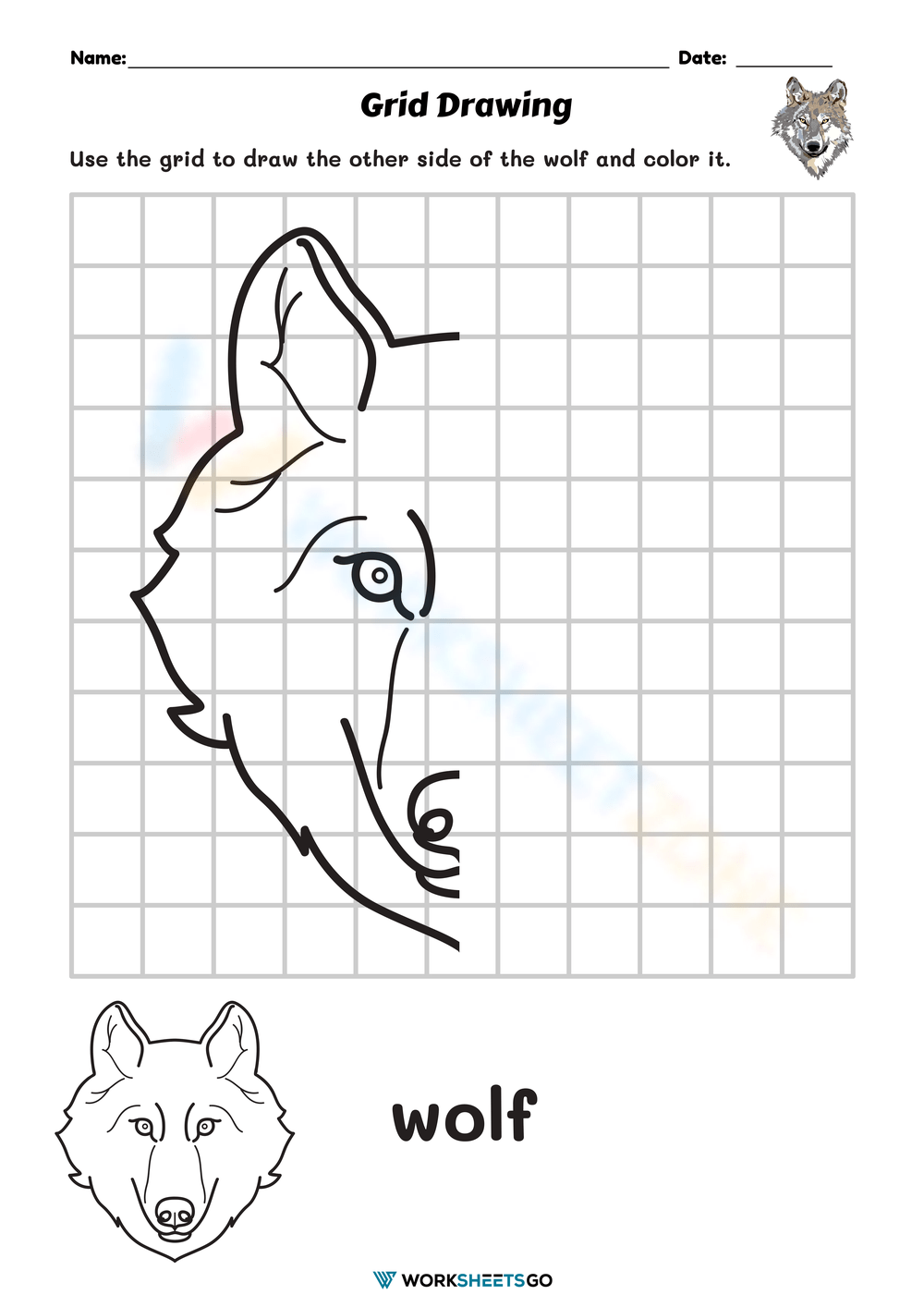
Grid drawing realistic techniques involve transferring real photo visual references onto a partitioned matrix to systematically build spatial awareness, proportion estimation, and fine-motor precision in young learners. According to the National Art Education Association (NAEA), structured observational drawing exercises fundamentally enhance cognitive mapping and hand-eye coordination by teaching children to isolate complex forms into manageable geometric segments. Integrating printable Grid Drawing worksheets into daily curricula empowers educators and parents to scaffold realistic artistic rendering through direct visual comparison rather than abstract estimation.
Visual Learning & Skill Snapshot:
- Core Focus: Systematic photographic transfer through proportional matrix mapping.
- Target Skill: Spatial reasoning, visual discrimination, and accurate proportion estimation.
- Key Recommendation: Pair high-contrast photo references with simplified 2×2 or 4×4 grids for early learners.
Core Principles and Visual Learning Overview
Proportional coordinate mapping serves as the foundation for achieving realistic representation by retraining the visual cortex to trust physical observation over preconceived symbols. When children analyze high-resolution photo flashcards inside structured coordinate boxes, visual cognitive processing shifts from conceptual memorization to precise boundary and negative space evaluation. This methodology reduces cognitive overload, allowing early learners to map complex curves, angles, and contours square by square without feeling overwhelmed by the entire composition. Utilizing specialized Photo Flashcards alongside blank coordinate grids bridges the gap between abstract visual stimuli and concrete pencil-to-paper execution.
Key Specifications and Breakdown
| Age / Learning Stage | Visual Skill & Grid Ratio | Pedagogical Application & Scaffolding |
|---|---|---|
| Ages 4–6 (Early Foundation) | 2×2 Matrix / High-contrast silhouettes | Focuses on basic quadrant location, left-to-right scanning, and fundamental pencil control. |
| Ages 7–9 (Developing Cognition) | 4×4 Matrix / Real photographic subjects | Emphasizes proportion estimation, contour continuity, and detail alignment across adjacent grid lines. |
| Ages 10+ (Advanced Mastery) | 6×6+ Matrix / Complex real photo details | Refines sub-millimeter scale accuracy, shading gradients, and independent observational drafting. |
Structured visual scaling directly reinforces neurological pathways associated with spatial memory, bilateral coordination, and mathematical coordinate comprehension. — National Art Education Association (NAEA)
Step-by-Step Practical Application and Printing Guidelines
Executing successful observational drawing sessions requires high-contrast printing, durable cardstock, and clear visual alignment between the reference sheet and the working canvas. Educators should print target imagery and corresponding grid overlays at exact one-to-one scale ratios to prevent cognitive confusion during manual proportion transfer. Incorporating structured Educational Activities that combine tactile measurement tools with printed grids ensures that learners physically experience how coordinate lines correspond to real-world dimensions. Facilitators must encourage children to inspect individual squares independently, covering adjacent sections with a blank card to minimize visual distraction and improve concentration.
Common Challenges and How to Avoid Them
Distorted proportions and misplaced lines typically occur when learners attempt to draw the entire image at once instead of focusing on isolated coordinate squares. To eliminate this hurdle, instructors should encourage students to anchor key intersection points where lines cross grid boundaries before drawing continuous contours. Providing light gray reference lines on initial worksheets rather than heavy black borders also prevents visual fatigue and keeps the final artwork looking clean and realistic.
💬 Frequently Asked Questions
Explore More Free Learning Printables and Visual Activities on WePhotoAgency
Optimizing early cognitive development through structured observation requires a diverse library of professional visual resources. Explore the complete collection of downloadable templates, photo flashcards, and step-by-step drafting guides available at WePhotoAgency.com to support holistic classroom and homeschool instruction.
Visual Reference Gallery