
Introduction
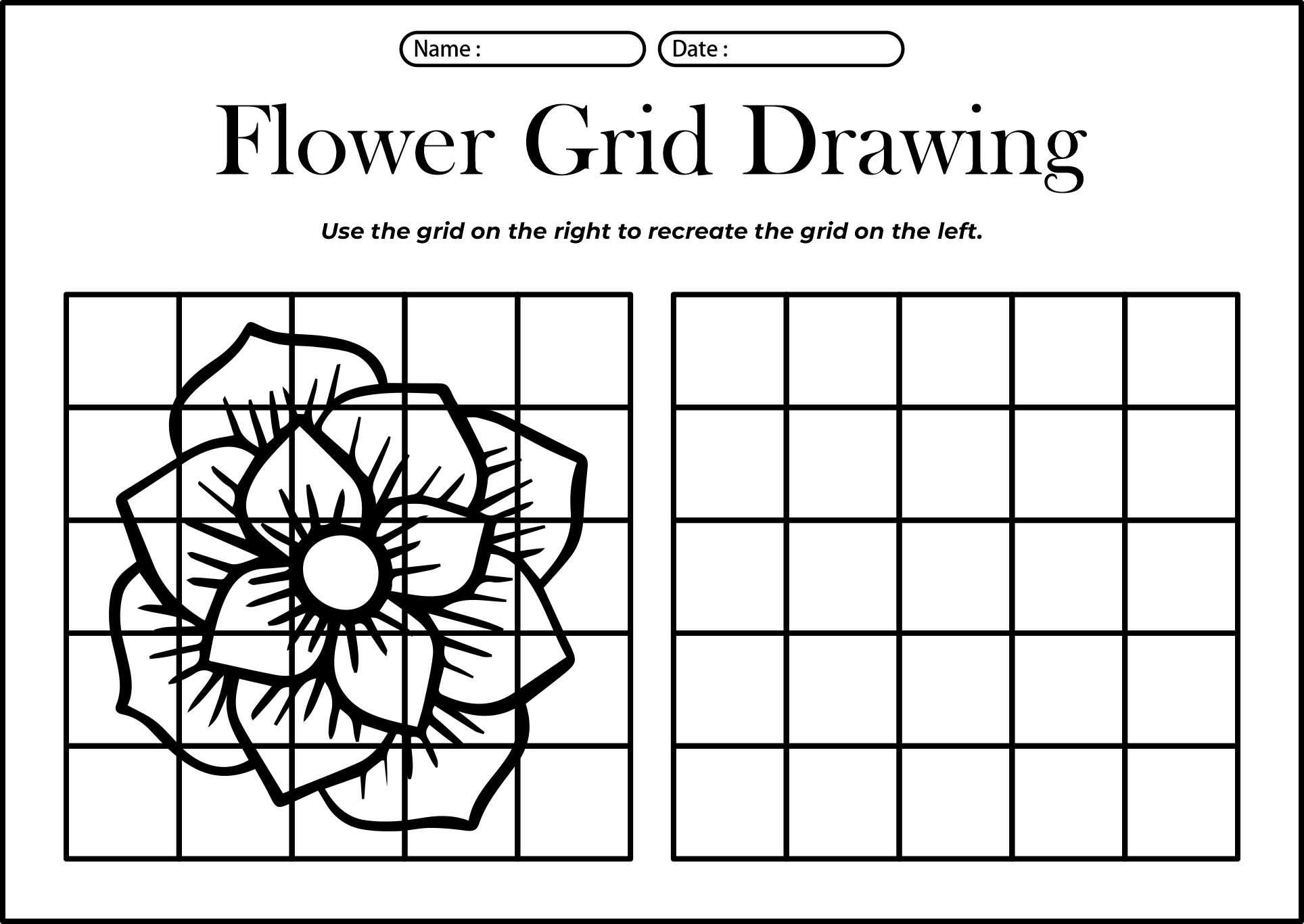
A grid drawing flower activity breaks complex botanical structures into manageable geometric coordinates, significantly accelerating childhood spatial awareness and visual-motor integration. According to the National Association for the Education of Young Children (NAEYC), hands-on visual arts experiences structured around geometric scaffolding actively strengthen children’s pre-mathematical thinking, analytical observation, and fine-motor control. Integrating printable Grid Drawing worksheets allows young learners to replicate realistic floral shapes square by square, transforming abstract observation into concrete cognitive processing.
Visual Learning & Skill Snapshot:
- Core Focus: Systematic reproduction of botanical subjects using coordinate-based visual fragmentation.
- Target Skill: Spatial reasoning, visual discrimination, fine-motor proportion, and photo-based concept mastery.
- Key Recommendation: Pair high-contrast floral reference images with simple 3×3 or 4×4 coordinate grids to prevent cognitive overload in early learners.
Core Principles and Visual Learning Overview
Mastering grid drawing flower exercises requires translating continuous organic curves into discrete coordinate segments, teaching young minds to analyze objects by segments rather than generic wholes. This developmental technique bridges the gap between symbol-drawing and realistic observation, aligning with principles found in professional Photo Flashcards and foundational art education. When children isolate a single petal within a grid quadrant, anxiety regarding overall proportion diminishes, enabling deep focus, sustained attention to detail, and a stronger comprehension of organic symmetry.
Key Specifications and Breakdown
| Age / Learning Stage | Visual Skill & Grid Ratio | Pedagogical Application & Scaffolding |
|---|---|---|
| Ages 4-6 (Early Primary) | 2×2 or 3×3 simple grid ratios focusing on bold primary botanical outlines. | Utilize large-format printables paired with tactile tracing tools to build basic coordinate mapping skills. |
| Ages 7-9 (Middle Elementary) | 4×4 or 5×5 moderate grids featuring complex layered petals and stems. | Integrate realistic photo references alongside blank grids to test proportional estimation independently. |
| Ages 10+ (Advanced Learners) | 6×6+ high-density grids requiring precise angle and negative space analysis. | Apply botanical shading and fine pencil cross-hatching to bridge academic art theory with natural science. |
Structured visual art methodologies measurably enhance cognitive mapping, hand-eye coordination, and perceptual organization across early childhood education. — National Art Education Association (NAEA)
Step-by-Step Practical Application and Printing Guidelines
Executing a successful grid drawing flower session begins with selecting high-resolution, high-contrast botanical photo templates that clearly delineate petal boundaries from background negative space. Educators and parents should print identical grid lines onto both the reference sheet and the working student canvas to ensure absolute geometric parity. Guide learners to scan the coordinate rows alphabetically or numerically—such as locating coordinate square B-2—and encourage pencil strokes that sketch light anchor points before committing to definitive contour lines. Incorporate varied Educational Activities to reinforce observational accuracy across different plant species.
Common Challenges and How to Avoid Them
Overcoming early learner frustration with grid drawing flower assignments requires addressing premature whole-drawing attempts and improper scaling habits. Children frequently abandon the coordinate box to draw the entire flower freehand, resulting in distorted proportions; educators must explicitly cover surrounding squares with a blank paper mask to force singular focus. Additionally, ensure that printouts maintain uniform grid square dimensions, as distorted rectangles immediately compromise the child’s spatial estimation and throw off angle replication.
💬 Frequently Asked Questions
Explore More Free Learning Printables and Visual Activities on WePhotoAgency
Expanding a child’s artistic and cognitive repertoire requires access to high-quality, professional educational materials designed for modern classrooms and homeschool environments. Educators and parents can discover an extensive library of printable resources, observational guides, and creative tools by visiting WePhotoAgency.com to support ongoing developmental growth.
Visual Reference Gallery


