Introduction
Grid drawing step by step is a foundational visual arts technique that breaks complex photographic references into manageable spatial coordinates to develop foundational proportion estimation and cognitive observation skills in early learners. According to the National Art Education Association (NAEA), structured visual exercises promote critical perceptual development and hand-eye coordination by teaching children to isolate details rather than relying on conceptual symbols. Mastering this method empowers young students to successfully navigate printable Grid Drawing worksheets while simultaneously boosting fine-motor confidence. Utilizing tangible materials alongside real-world references bridges the gap between abstract visual perception and concrete drawing execution for developing minds.
Visual Learning & Skill Snapshot:
- Core Focus: Systematic coordinate-based replication of real photographic references using proportional grid lines.
- Target Skill: Spatial reasoning, visual discrimination, fine-motor proportion, and photo-based concept mastery.
- Key Recommendation: Begin early learners with high-contrast, simple 4×4 grids before transitioning to complex photographic subjects.
Core Principles and Visual Learning Overview
Spatial awareness and proportion estimation are dramatically accelerated when children analyze images square by square rather than attempting to render an entire picture at once. Directing cognitive focus to a single isolated cell reduces visual overwhelm, allowing young artists to measure angles, line intersections, and negative space with pinpoint accuracy. Integrating printable Photo Flashcards as reference templates offers concrete visual anchors that make abstract scale conversion intuitive for early elementary students. This deliberate breakdown of visual information transforms daunting artistic tasks into achievable sequences, reinforcing sequential thinking and analytical problem-solving during everyday Educational Activities.
Key Specifications and Breakdown
| Age / Learning Stage | Visual Skill & Grid Ratio | Pedagogical Application & Scaffolding |
|---|---|---|
| Early Preschool (Ages 3-4) | 2×2 or 3×3 Grid; High Contrast | Use simple organic shapes and thick outlines to teach basic square identification. |
| Early Elementary (Ages 5-7) | 4×4 Grid; Real Photo References | Incorporate recognizable animal and object photographs to refine coordinate tracking. |
| Advanced Elementary (Ages 8-10) | 6×6 Grid; Detailed Proportions | Challenge students with complex shading, detailed textures, and scaled-up canvas sizes. |
Systematic visual breaking and coordinate mapping significantly enhance neurological spatial encoding and fine-motor precision in school-age children. — National Art Education Association (NAEA)
Step-by-Step Practical Application and Printing Guidelines
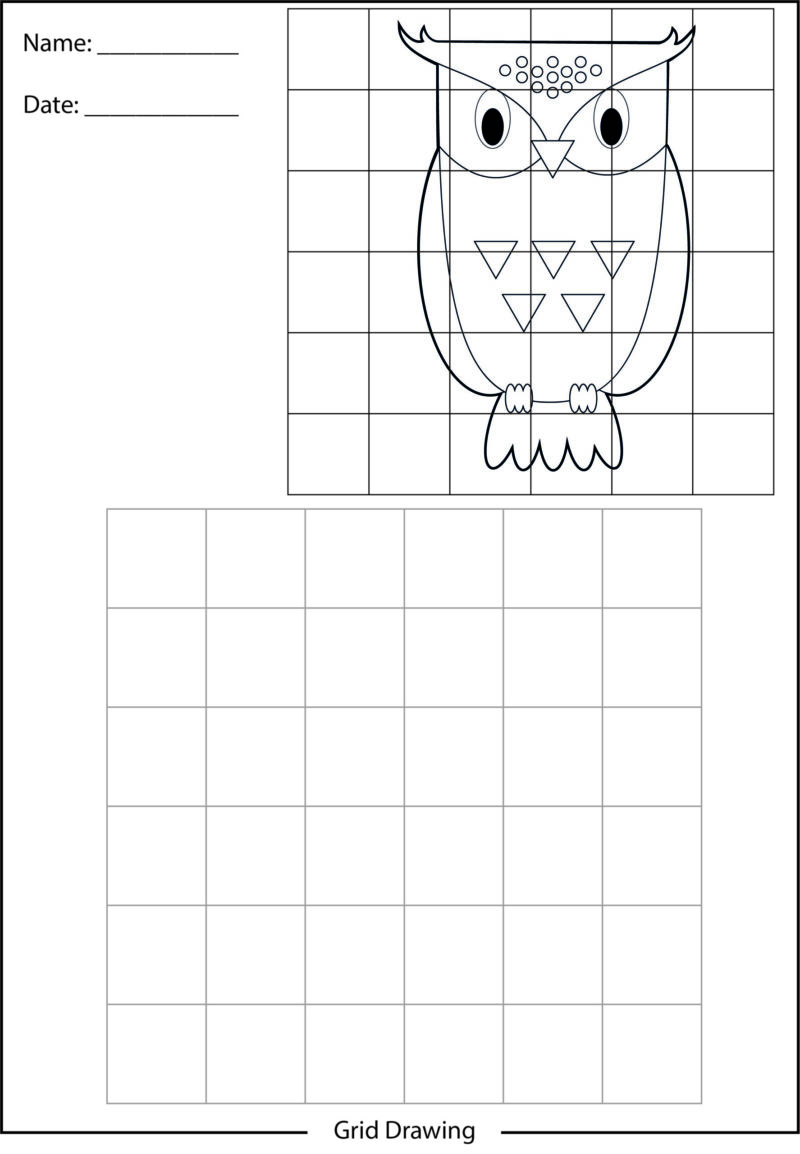
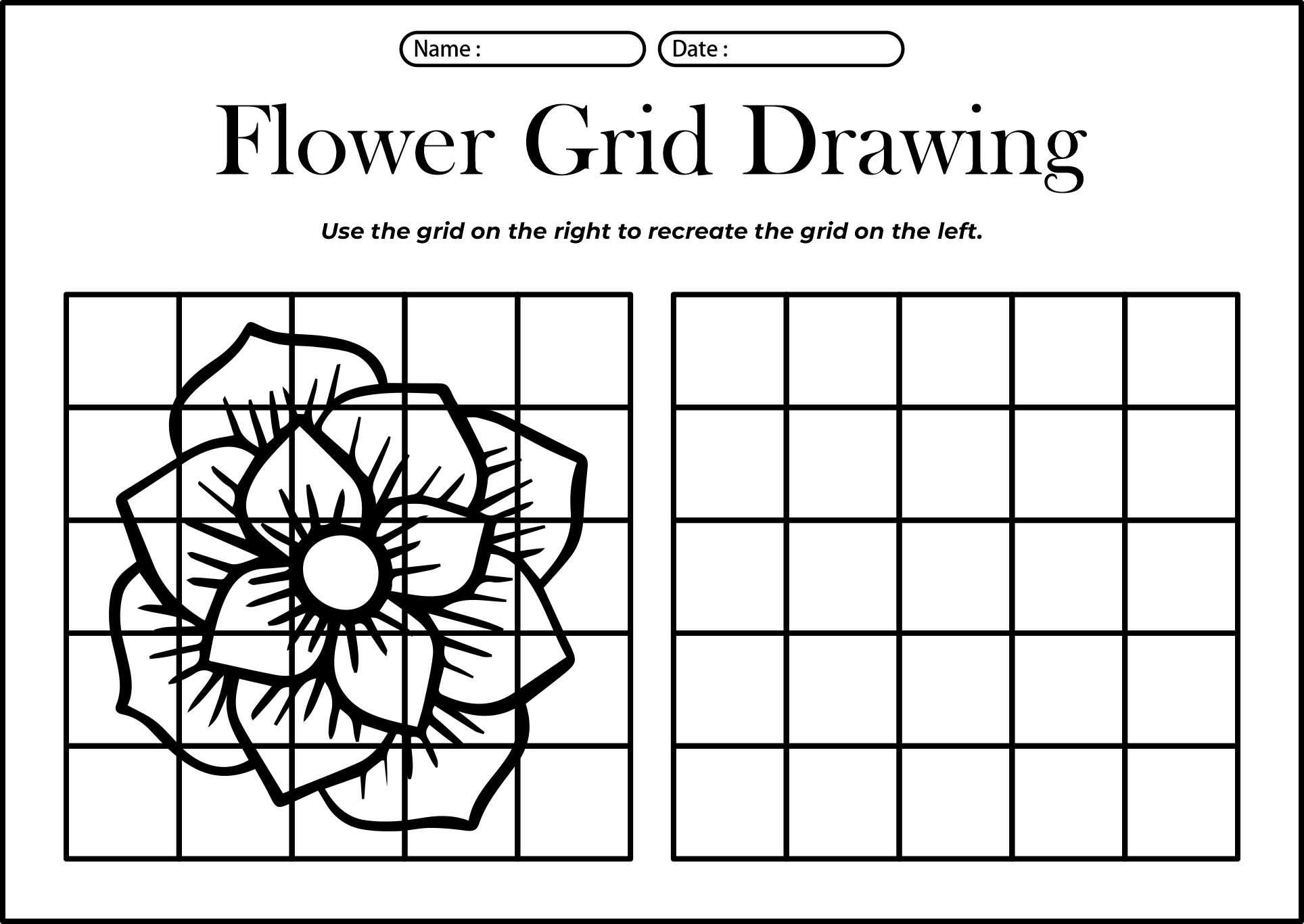
Executing a successful grid drawing begins by selecting a clear, high-contrast reference image and overlaying a uniform grid of squares across both the master photograph and the blank drawing sheet. Educators and parents must ensure that printouts maintain identical grid dimensions to prevent proportional distortion during student copying. Instruct learners to focus exclusively on one individual square at a time, observing precisely where lines enter and exit the grid borders before sketching the corresponding contours. Maintaining a light pencil touch during initial box-by-box transfer ensures easy error correction and paves the way for clean final linework or coloring.
Common Challenges and How to Avoid Them
Students frequently struggle with scale confusion by drawing elements too large in early cells, which can be easily prevented by teaching them to reference adjacent grid lines and corners as structural checkpoints. Another common pitfall involves rushing through intricate squares instead of verifying line placement against the original coordinate axes. Providing laminated worksheets and dry-erase markers allows children to practice coordinate mapping repeatedly without the frustration of permanent mistakes, building durable confidence in their observational powers.
💬 Frequently Asked Questions
Explore More Free Learning Printables and Visual Activities on WePhotoAgency
Unlocking young creative potential requires reliable, high-quality educational resources designed to foster genuine cognitive growth and artistic confidence. Parents, homeschoolers, and educators can discover an extensive library of printable learning sheets, visual exercises, and specialized tools by visiting WePhotoAgency.com today.
Visual Reference Gallery