Introduction
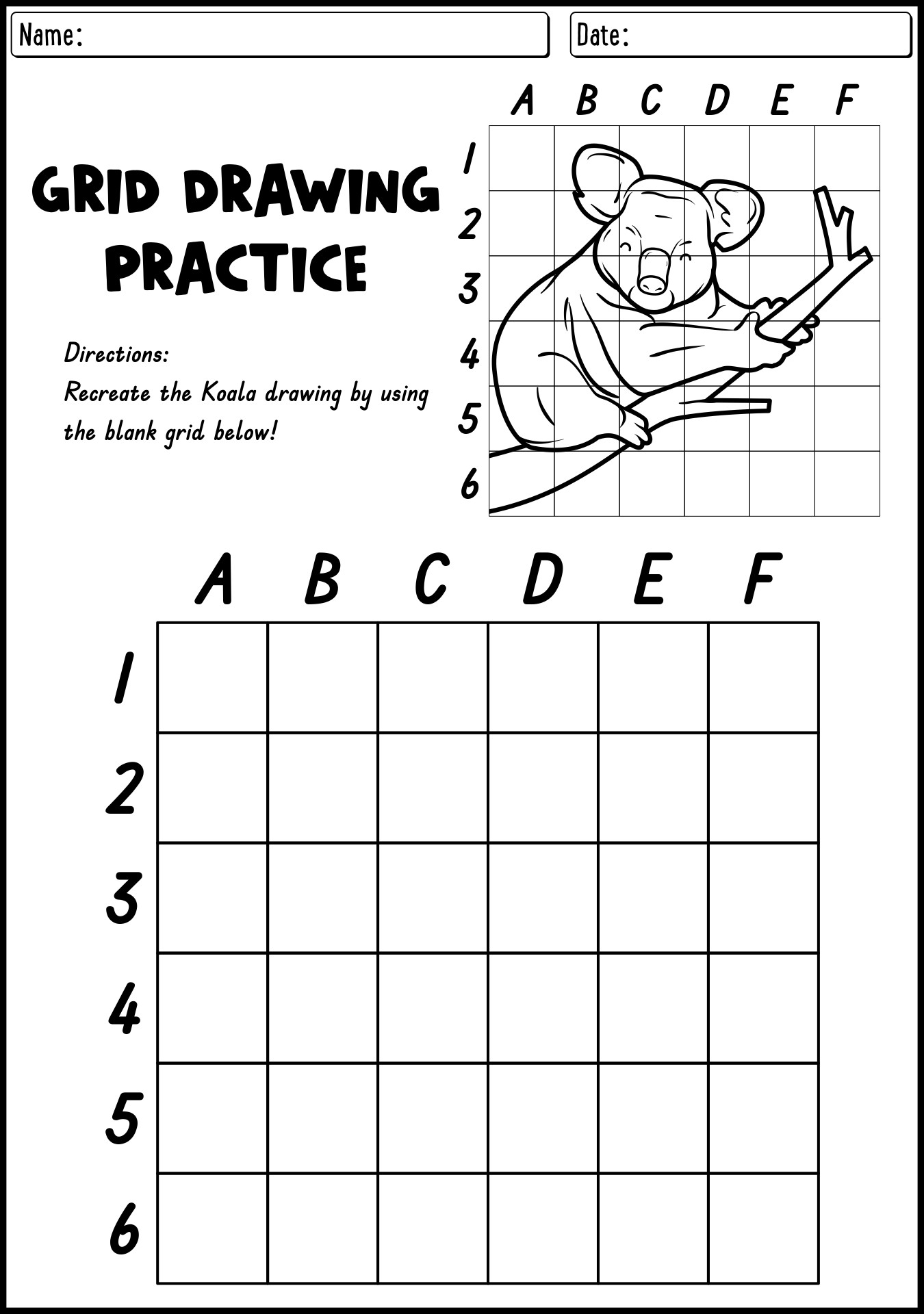
A grid drawing picture is a foundational educational tool that overlays a geometric matrix onto a visual subject, enabling learners to copy, scale, and reproduce imagery square by square with high precision. According to the National Art Education Association (NAEA), structured observational drawing techniques effectively bridge the developmental gap between abstract visual perception and concrete fine-motor execution in young learners. Utilizing printable Grid Drawing worksheets alongside realistic photo references transforms complex visual processing into manageable, bite-sized analytical tasks. Early childhood educators and homeschooling parents leverage these structured visual puzzles to accelerate spatial reasoning, hand-eye coordination, and proportional accuracy across diverse developmental stages.
Visual Learning & Skill Snapshot:
- Core Focus: Breaking complex visual compositions into smaller, manageable coordinate squares for accurate reproduction.
- Target Skill: Spatial reasoning, visual discrimination, fine-motor proportion, and photo-based concept mastery.
- Key Recommendation: Pair high-contrast photo references with simplified 2×2 or 4×4 grids before advancing to complex multi-row layouts.
Core Principles and Visual Learning Overview
Grid drawing picture frameworks function by training the human brain to detach from symbolic labeling—such as drawing what the mind thinks an object looks like—and focus purely on abstract lines, angles, negative space, and coordinates. When children analyze high-resolution Photo Flashcards divided by structural gridlines, cognitive processing shifts from holistic guessing to rigorous analytical measurement. This systematic methodology directly reinforces cognitive development by teaching children how to isolate specific quadrants, evaluate spatial relationships, and translate two-dimensional coordinates onto blank practice templates. Furthermore, incorporating diverse Educational Activities centered around geometric replication builds unwavering confidence in young artists and learners who might otherwise feel overwhelmed by blank paper.
Key Specifications and Breakdown
| Age / Learning Stage | Visual Skill & Grid Ratio | Pedagogical Application & Scaffolding |
|---|---|---|
| Ages 4-5 (Early Kindergarten) | 2×2 Matrix, High-Contrast Shapes | Focuses on basic contour recognition and gross spatial alignment using simple animal or object photos. |
| Ages 6-8 (Early Elementary) | 4×4 Matrix, Intermediate Detail | Teaches coordinate tracking, proportional scaling, and angle estimation using realistic nature and everyday object photography. |
| Ages 9-11 (Upper Elementary) | 6×6+ Matrix, Complex Imagery | Refines intricate shading, precise line intersections, and advanced perspective mapping through detailed architectural and wildlife photos. |
Structured observational drawing significantly enhances cognitive mapping, visual-spatial working memory, and fine-motor precision in school-age children. — National Art Education Association (NAEA)
Step-by-Step Practical Application and Printing Guidelines
Executing a successful grid drawing picture session requires high-visibility printouts, proper lighting, and distraction-free workspace preparation. Educators should begin by selecting clean, high-contrast photographic references that clearly outline distinct shapes and focal points. Print both the reference sheet featuring the overlaid grid and the corresponding blank grid worksheet on heavyweight cardstock to prevent pencil smudging and paper tearing during active erasing. Instruct learners to tackle the grid systematically, moving either row by row from top to left, or square by square starting from the central focal point. Emphasize light sketching during initial coordinate placement so students can easily adjust intersecting lines before finalizing contours with bold strokes or colored pencils.
Common Challenges and How to Avoid Them
Children frequently struggle with grid drawing pictures when attempting to fill out the entire composition at once instead of isolating individual squares. To prevent frustration, provide young learners with a cardboard “window” mask that reveals only one grid square at a time, effectively eliminating visual clutter and external distractions. Another common hurdle involves scaling errors where lines cross incorrectly from one coordinate box to the next; educators can resolve this by encouraging students to mark intersection points on the grid borders before drawing the actual connecting curves. Consistent, low-pressure practice with simple photo matrices ensures that children develop steady patience, sharp observational habits, and enduring confidence in their drawing abilities.
💬 Frequently Asked Questions
Explore More Free Learning Printables and Visual Activities on WePhotoAgency
Discover an extensive library of premium downloadable resources, structured worksheets, and creative visual tools designed to support holistic childhood development by visiting WePhotoAgency.com. Empower educators, parents, and young learners today with innovative materials tailored for every educational milestone.
Visual Reference Gallery