
Introduction
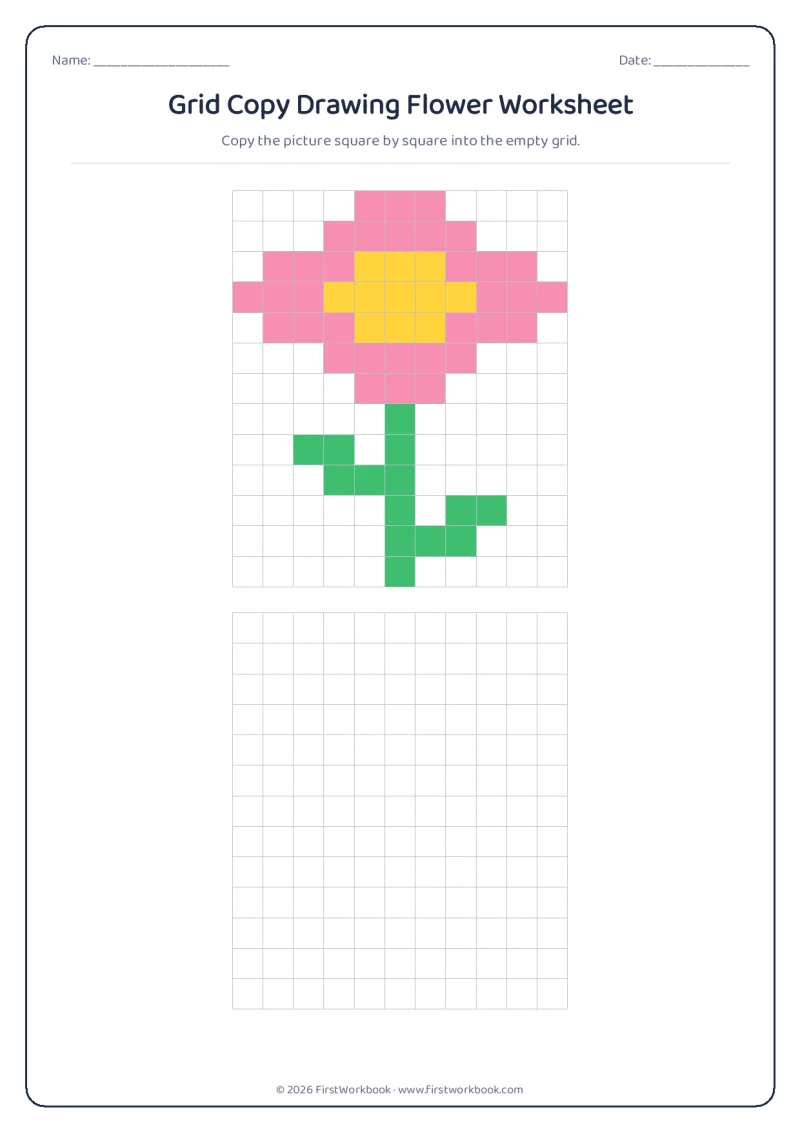
A grid drawing of a flower is a systematic visual learning technique that breaks complex natural forms into manageable coordinate sections to teach children proportion, scale, and spatial awareness. According to the National Association for the Education of Young Children (NAEYC), purposeful visual arts experiences combined with structured geometric tasks significantly enhance early spatial reasoning, bilateral coordination, and observational precision in young learners. Integrating printable worksheets alongside detailed Photo Flashcards transforms organic botany into approachable, concrete coordinates. This practice bridges abstract art concepts with tactile execution, establishing a solid foundation for early geometry, reading readiness, and meticulous visual discrimination.
Visual Learning & Skill Snapshot:
- Core Focus: A grid drawing of a flower translates organic petal and stem shapes into isolated coordinate boxes for accurate replication.
- Target Skill: Spatial reasoning, visual discrimination, fine-motor proportion estimation, and botanical observation.
- Key Recommendation: Pair high-contrast botanical photo references with large 3×3 grids before progressing to complex multi-box ratios.
Core Principles and Visual Learning Overview
Spatial analysis forms the cognitive foundation of a successful grid drawing of a flower by teaching children to isolate individual visual segments instead of viewing a complex blossom as an overwhelming whole. When young artists focus on a single coordinate box containing a curved petal edge or a central stamen, working memory manages smaller amounts of visual data without cognitive overload. Utilizing high-resolution imagery from Grid Drawing libraries ensures that students analyze authentic botanical textures, light gradients, and natural asymmetries. This method trains the brain to measure angles and distances relative to grid intersections, developing foundational mental rotation skills that transfer directly to geometry, handwriting alignment, and advanced STEM subjects.
Key Specifications and Breakdown
| Age / Learning Stage | Visual Skill & Grid Ratio | Pedagogical Application & Scaffolding |
|---|---|---|
| Ages 4–5 (Preschool) | 2×2 Grid with Bold Botanical Contours | Focus on macro flower elements like sunflower centers using large primary shapes and tactile tracing markers. |
| Ages 6–7 (Early Elementary) | 3×3 Grid with Standard Photo References | Isolate complex petals and stems, teaching coordinate mapping and basic horizontal-vertical line alignment. |
| Ages 8–10 (Advanced Primary) | 4×4 or 5×5 Grid with Detailed Anatomy | Emphasize proportion estimation, shading depth, botanical accuracy, and independent grid scaling. |
Structured grid-based drawing methodologies significantly enhance visual-spatial working memory, proportional accuracy, and fine-motor coordination by reducing complex cognitive loads into discrete perceptual units. — National Art Education Association (NAEA)
Step-by-Step Practical Application and Printing Guidelines
Executing a structured grid drawing of a flower requires pairing a master botanical reference image with a corresponding blank coordinate template printed on heavy cardstock to prevent pencil tear-through. Educators and parents should instruct children to scan the grid sequentially from top-left to bottom-right, identifying where specific petal lines intersect horizontal and vertical coordinate axes. Using light graphite pencils for initial coordinate mapping allows young learners to erase stray alignment marks before finalizing line work with colored pencils or fine-tip markers. Incorporating diverse Educational Activities alongside these printables reinforces cross-curricular connections between art, botany, and mathematics.
Common Challenges and How to Avoid Them
Children frequently struggle with proportion distortion when rushing through a grid drawing of a flower without verifying intersection points across neighboring coordinate boxes. To prevent this common obstacle, encourage young learners to place a finger or index card on the corresponding reference square to isolate the immediate visual data before drawing. If a child becomes overwhelmed by intricate petal details, instructors should substitute the primary reference with a simpler, high-contrast daisy or tulip photograph featuring clear, distinct outlines. Establishing slow, deliberate observation habits prevents frustration and ensures that spatial mapping remains an engaging, confidence-building exercise rather than a test of raw artistic perfection.
💬 Frequently Asked Questions
Explore More Free Learning Printables and Visual Activities on WePhotoAgency
Enhance early childhood curriculums, homeschool environments, and art studios by exploring the comprehensive collection of printable worksheets, visual learning guides, and creative resources available through WePhotoAgency.com. Accessing professionally curated drawing templates and visual flashcards ensures engaging, structured skill development for every young learner.
Visual Reference Gallery


