Introduction
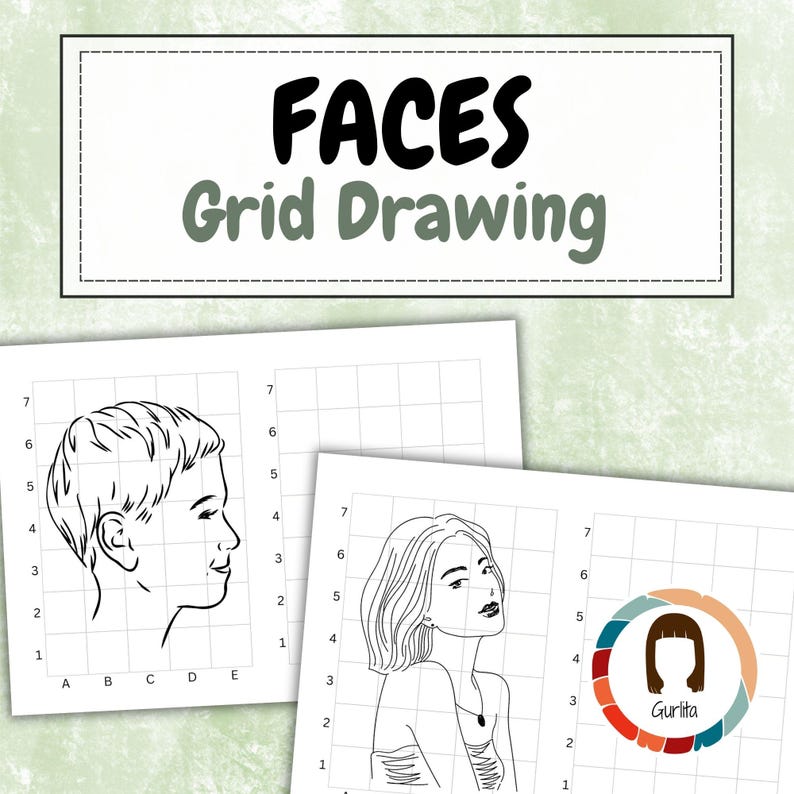
A grid drawing eye exercise involves breaking down the complex anatomical features of an eye into manageable, proportional coordinate squares to teach spatial estimation and observational accuracy. According to the National Art Education Association (NAEA), structured visual-spatial training during early childhood directly enhances cognitive mapping, fine-motor coordination, and geometric understanding. By isolating photographic references inside printable coordinate networks, young learners transition from abstract symbol drawing to authentic visual observation. Educators leverage these multi-sensory printables to build foundational geometry and artistic confidence without overwhelming young minds. Exploring dedicated resources like Grid Drawing collections provides structured templates that accelerate this developmental progression seamlessly.
Visual Learning & Skill Snapshot:
- Core Focus: Mastering proportional replication of biological forms using coordinate grids and real photographic references.
- Target Skill: Spatial reasoning, visual discrimination, fine-motor proportion, and photo-based concept mastery.
- Key Recommendation: Pair high-contrast macro photographs with simple 2×2 or 3×3 grids before scaling up to higher-density matrices.
Core Principles and Visual Learning Overview
Spatial reasoning development relies on breaking complex continuous forms into isolated, low-stress geometric segments that young brains can process sequentially. The grid drawing eye methodology reduces cognitive overload by shifting focus from the entire subject to individual grid intersections, lines, and negative spaces. Utilizing high-resolution Photo Flashcards alongside coordinate templates reinforces visual perception by linking realistic imagery directly to structural mapping exercises. Children learn to evaluate relative distances, curve angles, and line placement independently, fostering critical analytical thinking alongside traditional artistic execution.
Key Specifications and Breakdown
| Age / Learning Stage | Visual Skill & Grid Ratio | Pedagogical Application & Scaffolding |
|---|---|---|
| Ages 4-5 (Early Explorers) | 2×2 Matrix, High-Contrast Macros | Focuses on corner identification, basic line direction, and gross shape matching using large-format worksheets. |
| Ages 6-7 (Developing Artists) | 3×3 Matrix, Moderate Detail | Introduces curved contour mapping, pupil alignment, and eyelid arc proportion within structured boundaries. |
| Ages 8-9 (Advanced Observers) | 4×4 Matrix, Fine Anatomical Elements | Emphasizes shading transitions, iris detailing, lash direction, and precise coordinate transfer techniques. |
Structured visual partitioning significantly improves hand-eye coordination, spatial memory, and geometric problem-solving in early learners — National Art Education Association (NAEA)
Step-by-Step Practical Application and Printing Guidelines
Effective implementation requires crisp, distortion-free printouts paired with high-contrast photographic references to ensure optimal visual tracking. Educators must print worksheets on heavyweight matte cardstock to prevent pencil tearing during repeated erasing and refinement cycles. Begin the exercise by having children identify specific coordinate boxes, such as locating the pupil in row two, column two, before attempting to sketch any lines. Integrating these structured tasks into daily Educational Activities establishes a reliable routine for building sustained concentration and meticulous observation habits.
Common Challenges and How to Avoid Them
Learners frequently experience frustration when attempting to draw the entire eye at once instead of concentrating on one isolated grid square at a time. To resolve this hurdle, supply index cards or masking windows to physically cover surrounding squares, forcing the brain to process shapes purely by abstract geometry rather than preconceived symbols. Another frequent obstacle involves incorrect line scaling; educators should explicitly demonstrate how to measure grid boundaries with a finger or ruler to maintain accurate proportions across corresponding squares.
💬 Frequently Asked Questions
Explore More Free Learning Printables and Visual Activities on WePhotoAgency
Accessing comprehensive visual learning libraries ensures continuous developmental growth through engaging, expertly crafted printables designed for home and classroom environments. Discover an extensive collection of skill-building templates, flashcards, and step-by-step drawing guides by exploring the primary catalog at WePhotoAgency.com.
Visual Reference Gallery