Introduction
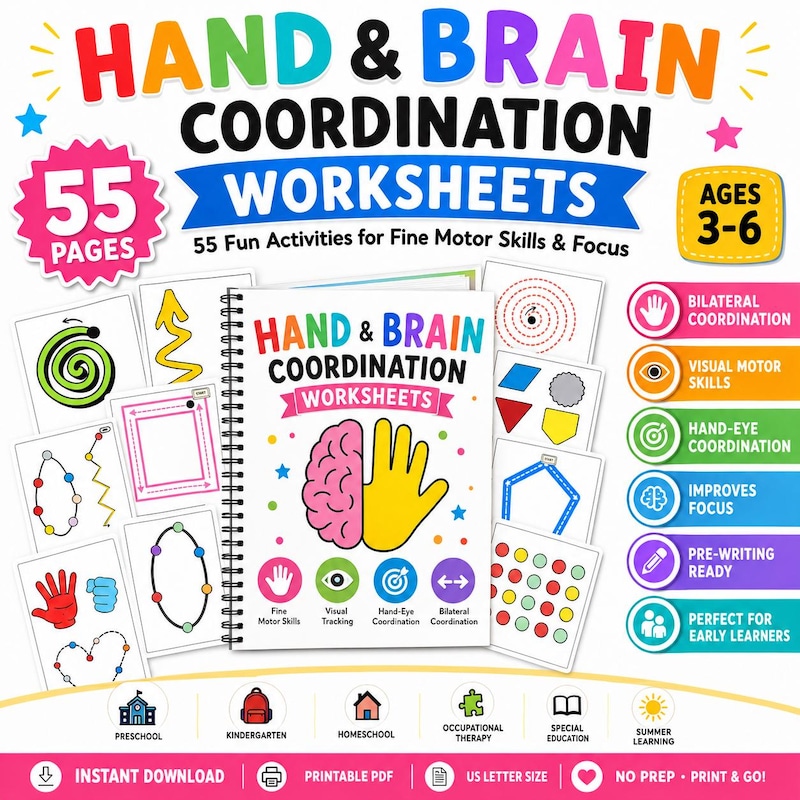
Brain stem activities for kids target foundational sensory-motor foundations, primitive reflex integration, and physical regulation necessary for advanced cognitive processing and visual-spatial learning. According to the National Association for the Education of Young Children (NAEYC), integrated motor-sensory experiences directly support young children in developing the neural pathways required for complex academic tasks, visual observation, and fine-motor control. When early educators integrate foundational physical regulation exercises alongside structured visual tasks such as Grid Drawing, learners build stronger cross-hemispheric communication. This comprehensive resource examines how physical grounding methodologies intersect with printable learning materials to optimize early childhood development.
Visual Learning & Skill Snapshot:
- Core Focus: Activating the lower neurological centers through structured physical movement and visual-spatial tracking exercises.
- Target Skill: Spatial reasoning, visual discrimination, fine-motor proportion, and photo-based concept mastery.
- Key Recommendation: Pair gross-motor grounding exercises with high-contrast printables to anchor attention before detailed drawing tasks.
Core Principles and Visual Learning Overview
Brain stem activities for kids establish neurological regulation by engaging the lower brain centers responsible for alertness, balance, and proprioceptive feedback before transitioning to higher-order cortical tasks. Utilizing Photo Flashcards provides children with concrete visual anchors that stimulate rapid object recognition and categorization. By systematically combining physical grounding techniques with proportional measurement tasks, educators help children transition from unregulated physical energy into focused visual observation. This progression enhances hand-eye coordination, reduces cognitive overload, and strengthens the child’s capacity to translate three-dimensional spatial awareness into accurate two-dimensional representations on paper.
Key Specifications and Breakdown
| Age / Learning Stage | Visual Skill & Grid Ratio | Pedagogical Application & Scaffolding |
|---|---|---|
| Ages 3-4 (Early Explorer) | 1×1 to 2×2 Large Grids | Focuses on gross spatial mapping using tactile photo references and thick-line printable cards. |
| Ages 5-7 (Developing Artist) | 3×3 to 4×4 Standard Grids | Builds proportion estimation and hand-eye coordination using real photo visual stimuli. |
| Ages 8-10 (Advanced Learner) | Multi-Cell Complex Grids | Refines precise observation skills, symmetrical balance, and detailed visual scaling techniques. |
Early sensorimotor experiences and foundational physical regulation exercises are essential prerequisites for higher-level spatial reasoning and academic achievement. — National Association for the Education of Young Children (NAEYC)
Step-by-Step Practical Application and Printing Guidelines
Implementing brain stem activities for kids requires a structured sequence that begins with physical balance tasks, transitions to observation using Educational Activities, and concludes with fine-motor application. Educators should print worksheets on heavy cardstock to prevent tearing during pencil pressure adjustments, ensuring crisp grid lines remain visible. Instructors must first guide learners through grounding movements, such as cross-lateral crawling or balance poses, to calm the nervous system. Following this physical preparation, present the reference photo and corresponding grid worksheet side-by-side on a flat surface, encouraging children to inspect individual squares systematically rather than attempting to draw the entire image at once.
Common Challenges and How to Avoid Them
Frustration during visual-spatial exercises typically stems from skipped physical preparation or overwhelming grid complexity that bypasses the child’s current developmental stage. Children frequently attempt to draw entire objects at once instead of isolating individual grid squares, leading to proportion distortion and cognitive fatigue. Educators can resolve this by re-engaging brief physical grounding routines when attention wanes, and by covering unused grid rows with a blank card to isolate the immediate focal area. Scaffolding the activity with simpler grid ratios ensures children experience steady success and maintain healthy visual-motor confidence.
💬 Frequently Asked Questions
Explore More Free Learning Printables and Visual Activities on WePhotoAgency
Discover an extensive library of professional early childhood resources, downloadable worksheets, and developmental guides by visiting WePhotoAgency.com today. Empower your teaching environment with tools designed to foster visual literacy, cognitive growth, and lifelong creative confidence.
Visual Reference Gallery