Introduction
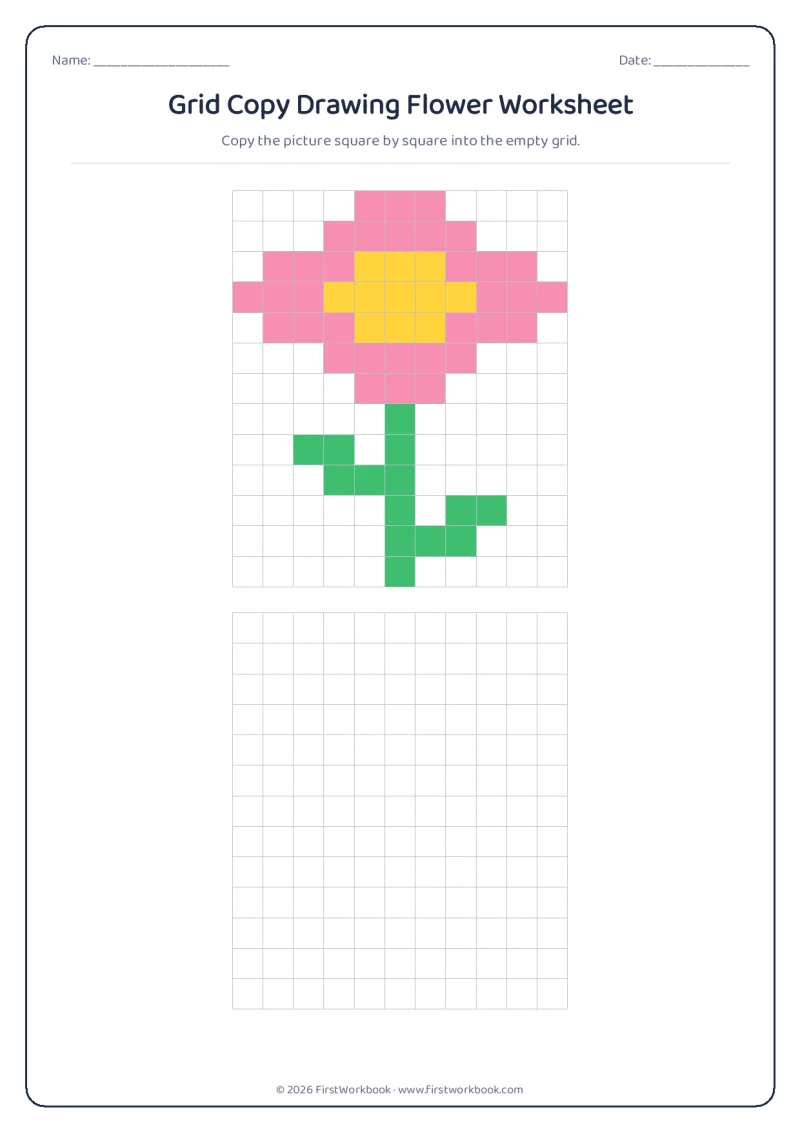
Grid drawing of ganesh ji is a structured visual art exercise that breaks down complex iconographic forms into manageable geometric squares, significantly improving spatial awareness, proportion estimation, and observation skills in early learners. According to the National Association for the Education of Young Children (NAEYC), structured tactile and visual arts experiences actively foster cognitive development, hand-eye coordination, and fine-motor precision during the formative educational years. Educators and parents utilize printable grid worksheets alongside real photo visual flashcards to scaffold difficult artistic tasks, allowing children to focus on one coordinate block at a time rather than becoming overwhelmed by an entire intricate illustration.
Visual Learning & Skill Snapshot:
- Core Focus: Geometric breakdown of traditional iconography using coordinate squares for accurate artistic replication.
- Target Skill: Spatial reasoning, visual discrimination, fine-motor proportion, and photo-based concept mastery.
- Key Recommendation: Pair photographic reference materials with simple 4×4 or 6×6 printable grids to build foundational confidence before attempting complex details.
Core Principles and Visual Learning Overview
Spatial decomposition through structured graphing teaches young artists to isolate lines, curves, and angles by mapping them coordinate by coordinate. This specialized method leverages materials found within curated collections such as Grid Drawing libraries, shifting a child’s cognitive focus from guessing an entire shape to analyzing the exact intersection of lines within a single square. When paired with high-definition Photo Flashcards, learners develop superior visual literacy by connecting photographic reference reality to structured line art translation. Early childhood development specialists emphasize that this analytical approach bridges the gap between abstract visual perception and concrete motor execution, making culturally rich subjects accessible to elementary students.
Key Specifications and Breakdown
| Age / Learning Stage | Visual Skill & Grid Ratio | Pedagogical Application & Scaffolding |
|---|---|---|
| Ages 4-6 (Early Foundation) | Basic 2×2 or 4×4 Grid Matrix | Focuses on gross shape placement, massive curves, and basic hand control using high-contrast reference images. |
| Ages 7-9 (Developing Mastery) | Standard 6×6 or 8×8 Grid Matrix | Targets intricate proportion alignment, curved trunk contours, and ear symmetry using detailed photographic prompts. |
| Ages 10-12 (Advanced Precision) | Complex 10×10 Fine Coordinate Grid | Emphasizes fine-line precision, intricate crown ornamentation, shadow mapping, and independent scaling without direct adult support. |
Structured visual art exercises systematically enhance neural pathway development for spatial reasoning and proportional analysis — National Art Education Association (NAEA)
Step-by-Step Practical Application and Printing Guidelines
Implementing structured graphic art activities requires high-contrast printing, clear coordinate labeling, and deliberate workspace organization to prevent cognitive overload. Educators should print worksheets on heavy-weight matte cardstock to withstand repeated pencil erasing and precise tracing during multi-session art projects. Integrating these printables into daily Educational Activities encourages students to compare individual grid coordinates systematically from top-left to bottom-right, reinforcing reading directionality alongside artistic skills. Providing a viewfinder tool cut from cardstock further isolates individual squares, training the juvenile eye to ignore surrounding distractions and concentrate solely on the targeted geometric segment.
Common Challenges and How to Avoid Them
Rushing through coordinate mapping and attempting to draw freehand across multiple grid squares simultaneously represent the most frequent pitfalls observed in early elementary classrooms. Instructors combat this by demonstrating how to check starting and ending points of lines relative to grid border intersections before making permanent pencil marks. If a child becomes frustrated with complex facial features or curved ornamentation, temporarily reducing the matrix complexity or introducing tactile reference objects re-engages cognitive curiosity without inducing performance anxiety.
💬 Frequently Asked Questions
Explore More Free Learning Printables and Visual Activities on WePhotoAgency
Expanding a child’s creative capabilities and cognitive toolkit requires access to reliable, high-quality, and professionally designed educational resources. Caregivers and educators can discover an extensive selection of printable templates, structured drawing guides, and visual learning aids by visiting the main repository at WePhotoAgency.com.
Visual Reference Gallery