Introduction
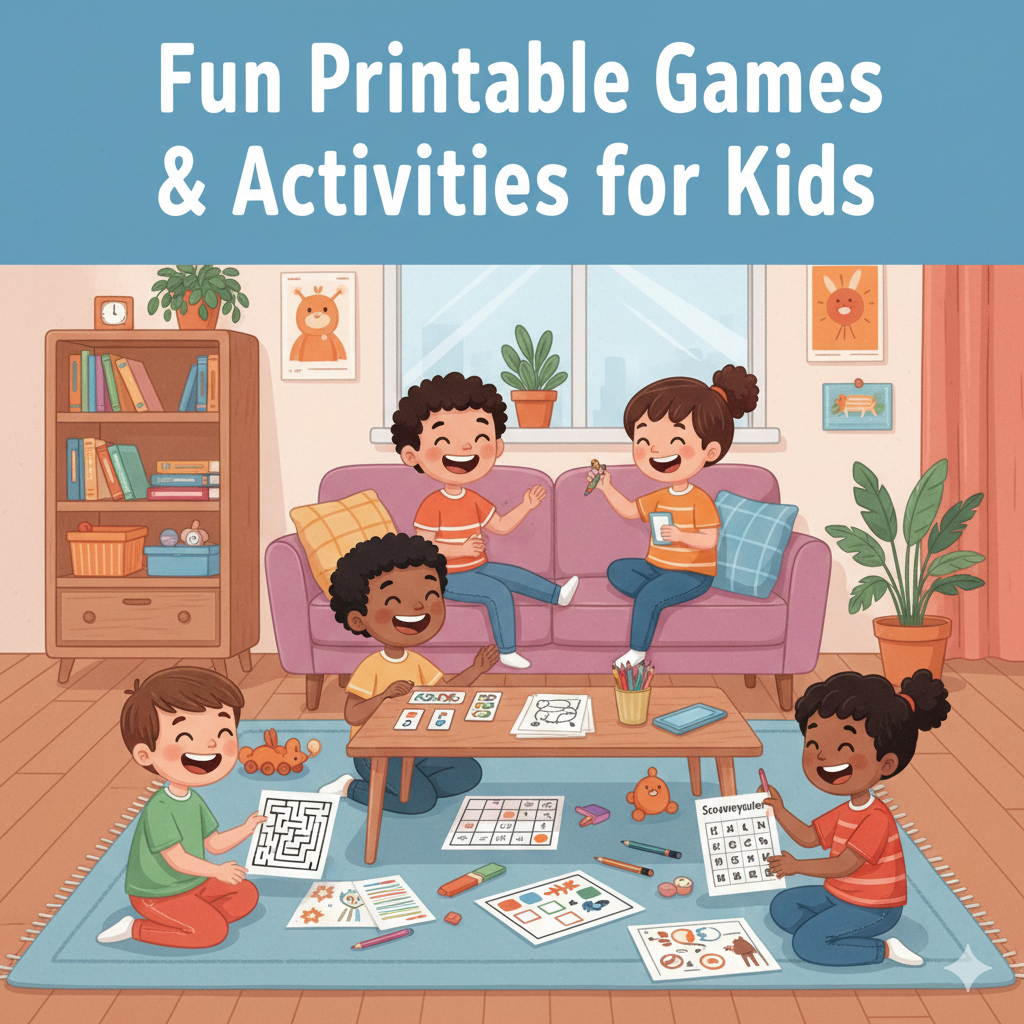
Educational activities for kids games systematically bridge creative play and cognitive development by utilizing structured visual tools to enhance spatial reasoning, fine motor coordination, and observational accuracy. According to the National Association for the Education of Young Children (NAEYC), purposeful play involving guided visual manipulation and structured drawing tasks supports foundational mathematics and literacy readiness by strengthening bilateral coordination and visual-spatial processing. Integrating printable worksheets and structured visual exercises into daily learning routines offers children an engaging method to interpret complex spatial environments through hands-on practice. Utilizing Educational Activities allows educators and parents to transform abstract geometric concepts into concrete, manageable visual tasks that support early childhood development.
Visual Learning & Skill Snapshot:
- Core Focus: Structuring educational activities for kids games through printable visual worksheets, photo flashcards, and coordinate grid drawing.
- Target Skill: Spatial reasoning, visual discrimination, fine-motor proportion, and real-world image observation.
- Key Recommendation: Pair high-contrast photographic references with scaled grid matrices to systematically build cognitive proportionality and focus.
Core Principles and Visual Learning Overview
Spatial awareness and proportion estimation develop efficiently when children engage with structured Grid Drawing worksheets that break complex images down into distinct, manageable coordinate boxes. By focusing on a single grid square at a time, young learners minimize cognitive overload, allowing the brain to process lines, angles, and negative space without feeling overwhelmed by the whole composition. Concurrently, utilizing Photo Flashcards provides children with authentic visual reference points that anchor abstract concepts into concrete real-world imagery. These combined educational activities for kids games cultivate analytical observation, teaching students to look past preconceived symbols of objects and instead observe true shapes, scale relationships, and spatial orientations.
Key Specifications and Breakdown
| Age / Learning Stage | Visual Skill & Grid Ratio | Pedagogical Application & Scaffolding |
|---|---|---|
| Ages 3–5 (Early Explorer) | 2×2 or 3×3 simple grids with high-contrast photographic cues | Focuses on basic shape recognition, matching objects, and developing initial pencil grip through guided tracing. |
| Ages 6–8 (Developing Artist) | 4×4 or 5×5 intermediate coordinate squares with real photo references | Builds proportion estimation, eye-hand coordination, and accurate observation of angles and intersecting lines. |
| Ages 9–12 (Advanced Learner) | 6×6+ complex grids and multi-point perspective scaling challenges | Enhances technical precision, independent spatial mapping, and advanced visual analysis of complex photographic subjects. |
Structured visual activities directly stimulate the parietal lobe, enhancing the neural pathways responsible for spatial processing, mathematical scaling, and geometric problem-solving in early childhood. — National Art Education Association (NAEA)
Step-by-Step Practical Application and Printing Guidelines
Implementing effective educational activities for kids games requires selecting high-resolution printable worksheets, preparing stable writing surfaces, and establishing a low-distraction workspace to maximize focus. Begin by printing grid worksheets and reference photo cards on heavy-weight cardstock to prevent tearing and bleeding from markers or colored pencils. Introduce the activity by demonstrating how to isolate a single grid square using a cardboard viewfinder, teaching the child to replicate only the lines visible within that specific coordinate. Encourage children to start sketching lightly with a graphite pencil before adding final ink or color, ensuring easy correction of proportion errors. Consistently rotate between different photographic subjects, ranging from natural elements to architectural structures, to maintain high engagement and diverse visual skill development.
Common Challenges and How to Avoid Them
Frustration during visual grid activities typically occurs when children attempt to copy the entire image at once rather than focusing on isolated coordinate squares. Educators and parents can eliminate this obstacle by providing opaque index cards or specialized viewfinders that isolate single squares, training the child’s brain to analyze abstract lines rather than named objects. Another frequent challenge involves improper scaling where initial marks drift off the designated grid boundaries; this is resolved by using light guide-dots at key intersection points to anchor the drawing. Patience, consistent positive reinforcement, and scaffolding complex images into simpler block references ensure that children build lasting confidence in their spatial estimation abilities.
💬 Frequently Asked Questions
Explore More Free Learning Printables and Visual Activities on WePhotoAgency
Expanding a child’s cognitive development through creative play requires access to structured, professional-grade visual resources designed for home and classroom environments. Discover a comprehensive collection of downloadable worksheets, photographic learning tools, and creative exercises by exploring the central learning hub at WePhotoAgency.com to elevate early childhood education today.
Visual Reference Gallery