
Introduction
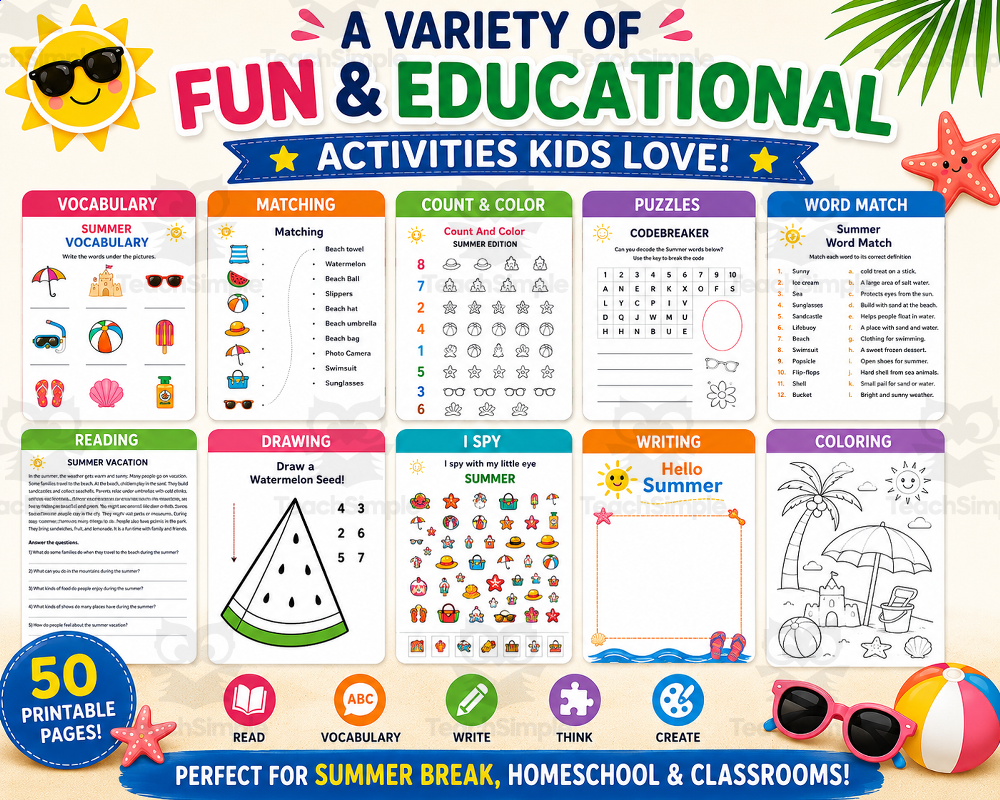
Educational activities for kids summer bridge formal academic calendars by utilizing targeted visual tools, structural worksheets, and observational exercises to prevent learning loss during seasonal breaks. According to the National Association for the Education of Young Children (NAEYC), purposeful hands-on play and structured visual exercises actively strengthen neural connections required for early literacy and mathematical proportion. Educators, art teachers, and homeschooling parents frequently seek reliable printables that combine fun seasonal aesthetics with rigorous cognitive development. Implementing structured Educational Activities during warmer months transforms ordinary downtime into a powerhouse of spatial reasoning and fine-motor mastery.
Visual Learning & Skill Snapshot:
- Core Focus: Seasonal learning strategies utilizing structured grid worksheets and photographic visual media.
- Target Skill: Spatial reasoning, visual discrimination, fine-motor proportion, and observation-based problem solving.
- Key Recommendation: Pair structured printable worksheets with real-world object matching to ground abstract concepts in tangible experience.
Core Principles and Visual Learning Overview
Structured visual resources foster cognitive development by breaking complex images into manageable coordinate sections that young learners can analyze independently. Utilizing precise Grid Drawing worksheets forces children to look past preconceived symbols and study the actual lines, angles, and negative spaces present in a subject. This observational training transfers directly to geometry, handwriting alignment, and reading fluency. Furthermore, incorporating Photo Flashcards featuring realistic objects, nature scenes, and architectural elements builds critical vocabulary while grounding visual comprehension in authentic photographic representations rather than simplified cartoon illustrations.
Key Specifications and Breakdown
| Age / Learning Stage | Visual Skill & Grid Ratio | Pedagogical Application & Scaffolding |
|---|---|---|
| Ages 4-5 (Early Learners) | 2×2 or 3×3 Large Scale | Focuses on basic contour tracking, matching large photographic blocks, and developing fundamental hand-eye coordination. |
| Ages 6-8 (Early Elementary) | 4×4 to 6×6 Intermediate | Emphasizes proportion estimation, coordinate mapping, and isolating individual quadrant lines from photographic references. |
| Ages 9-11 (Advanced Elementary) | 8×8 Complex Coordinate | Challenges spatial memory, exact angle replication, and detailed tonal shading through systematic grid replication. |
Visual-spatial training through structured grid drawing and photographic analysis significantly enhances proportional accuracy and mathematical coordinate comprehension in early childhood development. — National Art Education Association (NAEA)
Step-by-Step Practical Application and Printing Guidelines
Executing effective summer visual learning sessions requires preparing high-contrast printouts on durable cardstock to withstand repeated pencil strokes and eraser friction. Begin by selecting a grid worksheet that matches the developmental stage of the child, ensuring the reference photo is placed directly adjacent to the blank drawing grid for optimal side-by-side comparison. Instruct learners to cover all quadrants except the one currently under active observation, which reduces cognitive overwhelm and isolates spatial angles. Encourage light sketching of guide marks before committing to final dark lines, thereby reinforcing self-correction and iterative design thinking during every summer art session.
Common Challenges and How to Avoid Them
Overcoming frustration with proportions requires shifting a child’s focus from drawing the entire object at once to replicating individual line intersections within a single grid square. Many young learners attempt to rush through complex worksheets without checking coordinates, leading to skewed dimensions and misplaced features. Educators can resolve this by introducing a cardboard viewfinder frame to isolate specific sections of the reference image. Providing consistent, praise-focused feedback centered on observation accuracy rather than artistic perfection keeps motivation high throughout extended summer learning programs.
💬 Frequently Asked Questions
Explore More Free Learning Printables and Visual Activities on WePhotoAgency
Empowering young learners with high-quality visual tools ensures a seamless bridge between academic years and fosters lifelong creative confidence. Discover a comprehensive collection of downloadable worksheets, photographic resources, and developmental guides by exploring the extensive catalog at WePhotoAgency.com to elevate seasonal learning.
Visual Reference Gallery


