
Introduction
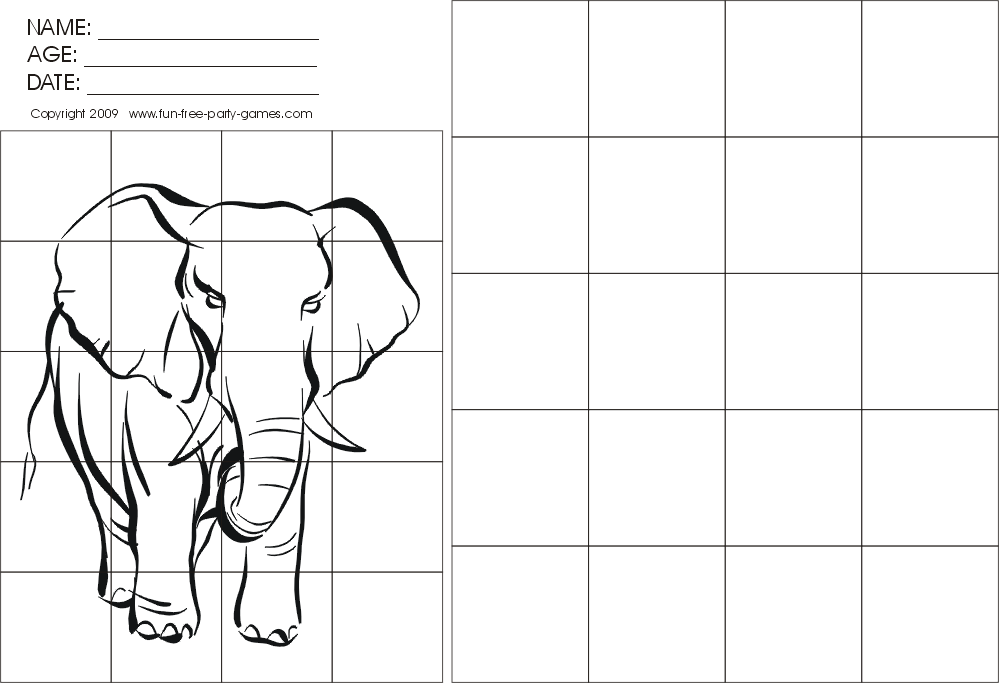
Grid drawing elephant worksheets serve as highly effective cognitive tools that translate complex organic shapes into manageable geometric coordinates for young learners. According to the National Art Education Association (NAEA), structured visual exercises grounded in systematic observation significantly accelerate spatial reasoning, fine-motor coordination, and proportional accuracy in early childhood development. Integrating printable Grid Drawing exercises bridges the gap between abstract mathematical grids and concrete biological observation. By segmenting a majestic African or Asian elephant photograph into distinct square quadrants, educators help children process visual data incrementally rather than becoming overwhelmed by the subject’s overall scale and intricate textures.
Visual Learning & Skill Snapshot:
- Core Focus: Systematic coordinate-based replication of realistic elephant anatomy using structured square grids.
- Target Skill: Spatial reasoning, visual discrimination, fine-motor proportion estimation, and photographic observation.
- Key Recommendation: Pair high-contrast photo templates with tactile Photo Flashcards to reinforce biological recognition before pencil meets paper.
Core Principles and Visual Learning Overview
Grid drawing elephant activities operate by training the developing brain to isolate individual fragments of visual information rather than relying on preconceived symbolic representations. When children attempt to draw an animal freehand, cognitive shortcuts often lead to generalized, inaccurate symbols. Imposing a structured coordinate grid forces the visual cortex to analyze negative space, line curvature, and intersection points within a single square at a time. This methodical deconstruction supports advanced Educational Activities designed to build cognitive endurance and meticulous attention to detail. Utilizing real photographic references instead of cartoon illustrations ensures that learners study authentic anatomical features—such as wrinkled skin textures, proportional ear spans, and tusk curvature—thereby enhancing scientific literacy alongside artistic capability.
Key Specifications and Breakdown
| Age / Learning Stage | Visual Skill & Grid Ratio | Pedagogical Application & Scaffolding |
|---|---|---|
| Ages 4-6 (Early Foundation) | 2×2 or 3×3 simple coordinate grid | Focuses on basic contour tracking, quadrant identification, and large motor pencil control. |
| Ages 7-9 (Skill Expansion) | 4×4 balanced reference matrix | Emphasizes proportional scaling, negative space awareness, and detailed trunk articulation. |
| Ages 10+ (Advanced Mastery) | 6×6 high-density photographic grid | Challenges shading transitions, fine textural accuracy, and complex anatomical perspective. |
Systematic visual division frameworks measurably enhance bilateral coordination, spatial memory retention, and geometric problem-solving in early childhood learners — National Art Education Association (NAEA)
Step-by-Step Practical Application and Printing Guidelines
Implementing a successful grid drawing lesson requires careful preparation of high-resolution printable templates and adequate workspace organization. Educators should select clear, high-contrast photographic references where the elephant stands out distinctly from the background environment. Print two identical copies of the worksheet: one featuring the complete gridded photograph and a blank counterpart featuring only the corresponding empty grid boxes. Instruct learners to start at the top-left coordinate square (labeled A1) and systematically replicate the intersecting lines into the matching blank square before moving horizontally or vertically. Providing mechanical pencils with soft lead prevents premature hand fatigue, while transparent plastic overlays allow younger children to practice tracing directly over photographic lines before transitioning to freehand coordinate transfer.
Common Challenges and How to Avoid Them
Young learners frequently encounter hurdles when transferring lines across grid coordinates, most notably skipping squares, misaligning intersection points, or rushing through complex anatomical curves like the ear and trunk. To prevent frustration, instructors should encourage children to use a finger or a blank index card to isolate one active square at a time, effectively blocking out visual distractions from surrounding quadrants. If a child struggles with proportional placement, verify that the reference grid and drawing grid maintain an exact 1:1 ratio to avoid cognitive confusion regarding scale. Emphasize that precision matters more than speed, framing the exercise as a fascinating puzzle rather than an intimidating art test.
💬 Frequently Asked Questions
Explore More Free Learning Printables and Visual Activities on WePhotoAgency
Empower young learners with an extensive collection of professional educational resources, structured art guides, and cognitive development tools available directly through WePhotoAgency.com. Discover a diverse library designed to foster creativity, critical thinking, and lifelong academic success.
Visual Reference Gallery


