Introduction
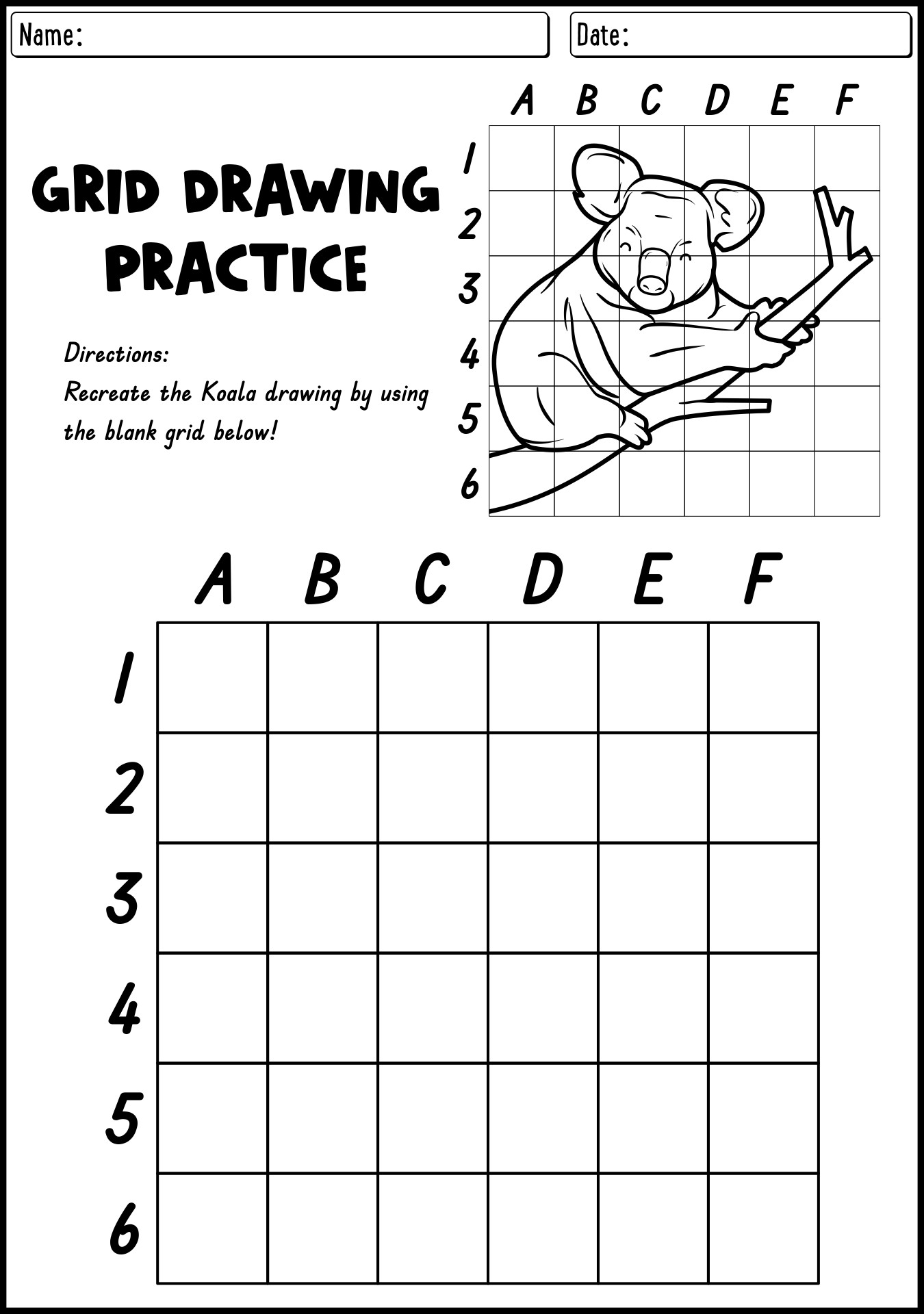
A grid drawing exercise breaks complex visual subjects down into manageable square coordinates, allowing children to decode spatial arrangements and replicate photographic details with high accuracy. According to the National Art Education Association (NAEA), structured observational drawing exercises significantly enhance visual-spatial processing and fine-motor coordination in early childhood learners. Utilizing printable Grid Drawing worksheets alongside real photographic references bridges the gap between abstract visual stimuli and concrete artistic execution. Educators, parents, and homeschoolers leverage these resources to foster rigorous concentration, patience, and geometric comprehension during formative developmental years.
Visual Learning & Skill Snapshot:
- Core Focus: Systematic coordinate mapping of photographic imagery onto structured grid matrices.
- Target Skill: Spatial reasoning, visual discrimination, fine-motor proportion, and photo-based concept mastery.
- Key Recommendation: Pair high-contrast real photo visual flashcards with simplified 2×2 or 3×3 grids for early learners before progressing to complex multi-square compositions.
Core Principles and Visual Learning Overview
Grid drawing exercises operate on the principle of perceptual fragmentation, training the human eye to isolate individual visual details rather than reacting to the overarching subject matter. When children focus exclusively on the contents of a single grid square—such as the curve of an animal’s ear or the shadow beneath a leaf—cognitive overload decreases and proportional accuracy naturally improves. This method leverages visual processing pathways associated with hemispheric integration, transforming raw sensory input from Photo Flashcards into structured graphic output. Incorporating these techniques into daily routines supports comprehensive Educational Activities designed to build cognitive stamina and analytical observation skills.
Key Specifications and Breakdown
| Age / Learning Stage | Visual Skill & Grid Ratio | Pedagogical Application & Scaffolding |
|---|---|---|
| Ages 4–6 (Early Primary) | 2×2 or 3×3 simple grid; high-contrast outlines | Focuses on basic shape recognition and teaching children to locate top, bottom, left, and right coordinates. |
| Ages 7–9 (Mid Elementary) | 4×4 intermediate grid; realistic photographic subjects | Develops precise angle estimation, line continuity across intersecting axes, and shading techniques. |
| Ages 10+ (Advanced Early Learning) | 6×6+ complex grid; detailed macro photography | Refines micro-proportion calculation, negative space observation, and independent self-correction strategies. |
Structured observational drawing tasks measurably advance eye-hand coordination, spatial working memory, and geometric schema formation in children aged four through ten. — National Art Education Association (NAEA)
Step-by-Step Practical Application and Printing Guidelines
Executing an effective grid drawing exercise requires clean, high-resolution printouts of both the reference image and the blank target template. Educators should print materials on heavy cardstock to prevent tearing and pencil bleed-through during intensive erasing cycles. Instruct learners to label horizontal axes with numbers and vertical axes with letters to establish a clear alphanumeric coordinate system. Children then scan the reference square, identify line intersections, and replicate those exact spatial vectors onto the corresponding square of the blank grid.
Common Challenges and How to Avoid Them
Young learners frequently encounter frustration when attempting to draw the entire subject at once instead of treating each square as an independent puzzle. To counter this common pitfall, provide a sliding cardboard window mask that isolates a single grid square on the reference sheet, blocking out extraneous visual distractions. Furthermore, ensure that print scales match identically between the source image and the drawing sheet to prevent proportional distortion caused by mismatched grid dimensions.
💬 Frequently Asked Questions
Explore More Free Learning Printables and Visual Activities on WePhotoAgency
Parents, educators, and homeschoolers seeking to expand their visual arts and cognitive development curriculums can access an extensive collection of professional resources, printable worksheets, and interactive guides directly through WePhotoAgency.com. Regular integration of structured drawing templates and visual media cultivates lifelong observational acuity, creative confidence, and academic readiness.
Visual Reference Gallery